Brazil is home to more Catholics than any other nation on Earth. Approximately 120 million Brazilians identify as Catholic, representing one of the largest concentrations of the faithful anywhere in the world. Yet within Brazil’s own borders lies a place that has shaped Catholic theology, missionary history, and the Church’s understanding of its relationship with Creation in ways that continue to resonate into the present day: the Amazon rainforest.
The Amazon is not simply a natural wonder. For Catholics who engage with the full depth of their tradition, it is a place where Scripture, history, theology, and living faith intersect in ways that few destinations on Earth can match. From the Jesuit missions of the colonial era to Pope Francis’s landmark 2019 Amazon Synod, the rainforest and the Church have been in active, sometimes painful, sometimes transformative dialogue for five centuries.
This article explores the Catholic dimensions of the Brazilian Amazon — its missionary heritage, its spiritual significance in Church teaching, the indigenous communities whose faith blends ancient tradition with Catholic devotion, and what it means for Catholic travelers to encounter this sacred place directly.
The Jesuit Missions and the Amazon’s Catholic History
The Catholic presence in the Amazon began with the Portuguese colonial expansion of the 16th century, when Jesuit, Franciscan, and Carmelite missionaries entered the region to bring the Gospel to indigenous peoples. The Jesuits in particular established a presence throughout the Amazon basin that would shape the region’s spiritual and cultural character for centuries.
The missionary enterprise in the Amazon was marked by genuine complexity. The Jesuits who entered the jungle learned indigenous languages, documented local knowledge, and sometimes defended native communities against the violence of colonial exploitation — a tension that has never been fully resolved in Catholic historical memory. The reduction system that the Jesuits developed in South America, creating protected Christian communities for indigenous peoples, represented an attempt to build a new form of Catholic civilization in the rainforest.
Many of the missionaries who worked in the Amazon died there. Some died of disease. Some died in conflict. Their graves are scattered throughout the region, marking a Catholic presence that predates modern Brazil itself. The martyrs of the Amazon occupy a specific place in the Church’s memory of how the faith was brought to the Americas — not without cost, not without contradiction, but with a dedication that the historical record cannot erase.
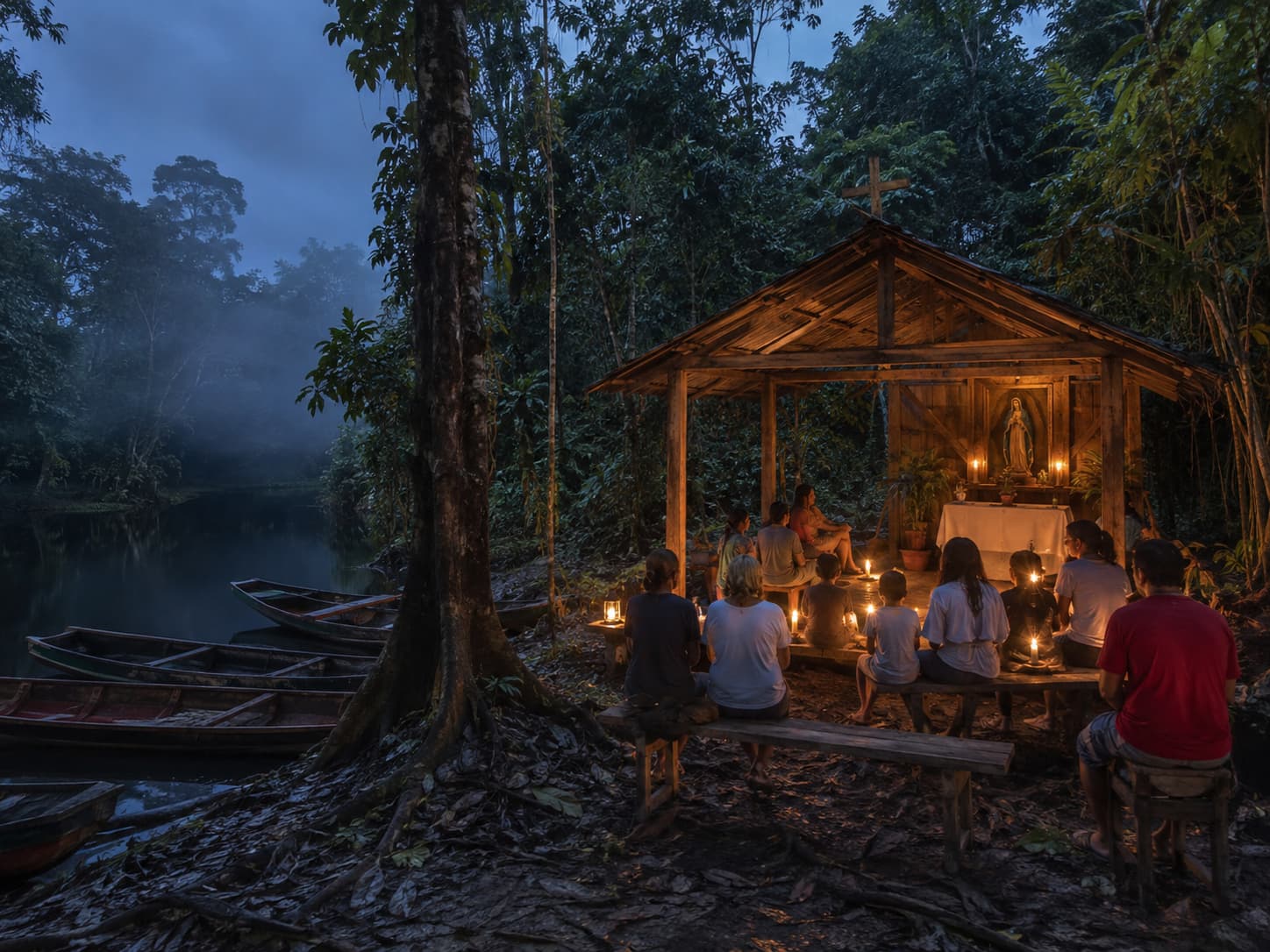
The Amazon’s Catholic missionary heritage is not only historical. In the centuries that followed, the Church continued to maintain a presence in some of the world’s most remote communities, with indigenous Catholic villages along river tributaries where Mass is celebrated in native languages and the saints are honored alongside ancestors in ways that reflect a genuine cultural synthesis.
Pope Francis and the Amazon Synod
In October 2019, Pope Francis convened the Special Assembly of the Synod of Bishops for the Pan-Amazon Region in Rome — one of the most significant gatherings in recent Church history, and one that placed the Amazon at the center of global Catholic attention.
The Amazon Synod, titled “Amazonia: New Paths for the Church and for an Integral Ecology,” brought together bishops, indigenous representatives, theologians, and Church leaders from nine Amazon countries to address a set of interconnected concerns: the destruction of the rainforest, the welfare of indigenous communities, the crisis of pastoral care in remote Amazon regions, and the theological meaning of the Amazon itself for the universal Church.
Pope Francis’s apostolic exhortation Querida Amazonia (Beloved Amazon), released in February 2020 as his response to the Synod, articulates a vision of the Amazon as a place of theological significance that exceeds its function as a natural resource or even an ecological system:
The Amazon is a multi-faceted reality — a territory of biological diversity, cultural variety, ancestral wisdom, and spiritual richness. The Church’s engagement with it is not only a matter of charity or justice, though it is those things. It is also a matter of encountering God’s Creation in a form that challenges every comfortable assumption about what modernity has built.
Pope Francis’s longstanding commitment to ecological theology, expressed through his 2015 encyclical Laudato Si’, finds its most acute application in the Amazon. The encyclical’s vision of integral ecology — the understanding that care for the poor and care for Creation are inseparable dimensions of the Christian vocation — is nowhere more urgently tested than in the rainforest, where indigenous communities and the most biodiverse ecosystem on Earth face the same threats simultaneously.
For Catholic travelers who have engaged with Laudato Si’ or Querida Amazonia, visiting the Amazon is not merely a tourist activity. It is an encounter with the subject of the Church’s most serious recent theological reflection on the relationship between faith and the natural world.
The Amazon as Sacred Creation: Theological Reflections
Catholic theology has always maintained that the natural world is sacred — not in a pantheistic sense, but in the sense that Creation bears the mark of its Creator and discloses something of God’s nature to those who encounter it with attentiveness. Saint Francis of Assisi, patron saint of ecology whose name Pope Francis deliberately chose, articulated this understanding most poetically in his Canticle of the Creatures, praising God through Brother Sun, Sister Moon, and Sister Earth.
The Amazon presents this theology in its most overwhelming form. The rainforest is the largest terrestrial biome on Earth, containing an estimated ten percent of all species on the planet. Its rivers and trees produce a fifth of the world’s freshwater and generate enough oxygen to meaningfully influence the global atmosphere. The biodiversity concentrated in a single hectare of Amazon forest exceeds what most people encounter in an entire lifetime of travel in more familiar environments.
For a Catholic who takes seriously the theological claim that every creature is a word spoken by God — that in the variety and specificity of Creation, something of divine creativity is revealed — walking through the Amazon is an encounter with revelation in its widest sense. The pink river dolphin, the howler monkey, the poison dart frog, the macaw, the giant water lily that can support the weight of a child — each of these creatures is, in the Catholic understanding of Creation, a specific gift of divine generosity that exists for its own sake and for God’s glory, not only for human utility.
This is not sentimentality. It is doctrine, and it is doctrine that the Amazon makes impossible to abstract. You cannot stand at the confluence of the Rio Negro and the Amazon River — where the dark water of one river and the sandy water of the other flow side by side for miles without mixing, one of the most extraordinary natural phenomena on Earth — and experience it as anything less than a witness to the Creator’s inexhaustible imagination.
Indigenous Catholic Communities and Living Faith
Along the tributaries and in the riverine communities of the Brazilian Amazon, there exists a form of Catholic faith that is unlike anything found in a city parish. Indigenous communities who received the Gospel centuries ago have developed distinctive expressions of Catholic devotion that blend the Church’s sacramental tradition with ancestral practices, local symbolism, and a relationship with the natural world shaped by generations of living within it.
In these communities, the liturgical year is marked by the rhythms of the Amazon — the rising and falling of rivers, the cycles of planting and harvest, the migration of fish and the flowering of forest plants. The saints are celebrated with specific local customs that reflect the community’s history and the particular forms that God’s presence has taken in their experience. Mass may be celebrated in indigenous languages. The images of Our Lady and the saints may be carved from local wood or depicted in local artistic traditions.
This is the inculturation of the Gospel that the Church has affirmed as both legitimate and necessary — the process by which the faith becomes genuinely rooted in a particular culture rather than remaining a foreign import. In the Amazon, this process has had five centuries to develop, producing forms of Catholic life that are simultaneously fully Catholic and distinctively Amazonian.
Visiting an indigenous community as part of an Amazon tour creates an opportunity to encounter this living faith directly. Several tours operated through Brazilian Amazon Tours include visits to indigenous communities along the river — stops where guides facilitate introductions to community members who share traditional knowledge, medicinal plant practices, and cultural customs that have evolved in relationship with both the forest and the Catholic faith.
The 3-Day Wildlife, Culture and Pink Dolphins Adventure, for example, includes an indigenous village visit alongside river wildlife experiences and the Meeting of the Waters. The overnight Rainforest Experience includes both a jungle survival component and a visit to an indigenous village, allowing travelers to encounter the human communities who have stewarded this landscape across many generations.
The Amazon and the Church’s Care for the Poor
Catholic Social Teaching has consistently affirmed that the fate of the poor and the fate of the Earth are connected. Pope Francis made this connection explicit in Laudato Si’ and applied it with particular intensity to the Amazon in Querida Amazonia. The communities most threatened by deforestation are also among the most economically vulnerable people in Brazil — indigenous groups, riverine communities, and small farmers whose livelihoods depend directly on the health of the forest and its waterways.
The Church’s network of missionaries, lay workers, and bishops throughout the Amazon region has been at the forefront of advocacy for these communities, sometimes at considerable personal risk. The murders of Sister Dorothy Stang in 2005 and journalist Dom Phillips and indigenous expert Bruno Pereira in 2022, both in the Amazon, are reminders that witness to justice in the rainforest carries real cost.
For Catholic travelers, understanding this dimension of the Amazon situation adds moral depth to a visit. Choosing to travel ethically — supporting local guides and community-based tourism rather than large-scale extractive operators — is itself an act aligned with Catholic Social Teaching’s principles of subsidiarity and care for the vulnerable. The operators listed through Brazilian Amazon Tours work with local guides who are community members, keeping the economic benefits of tourism within the communities who actually live in and steward the forest.
Spiritual Preparations for an Amazon Pilgrimage
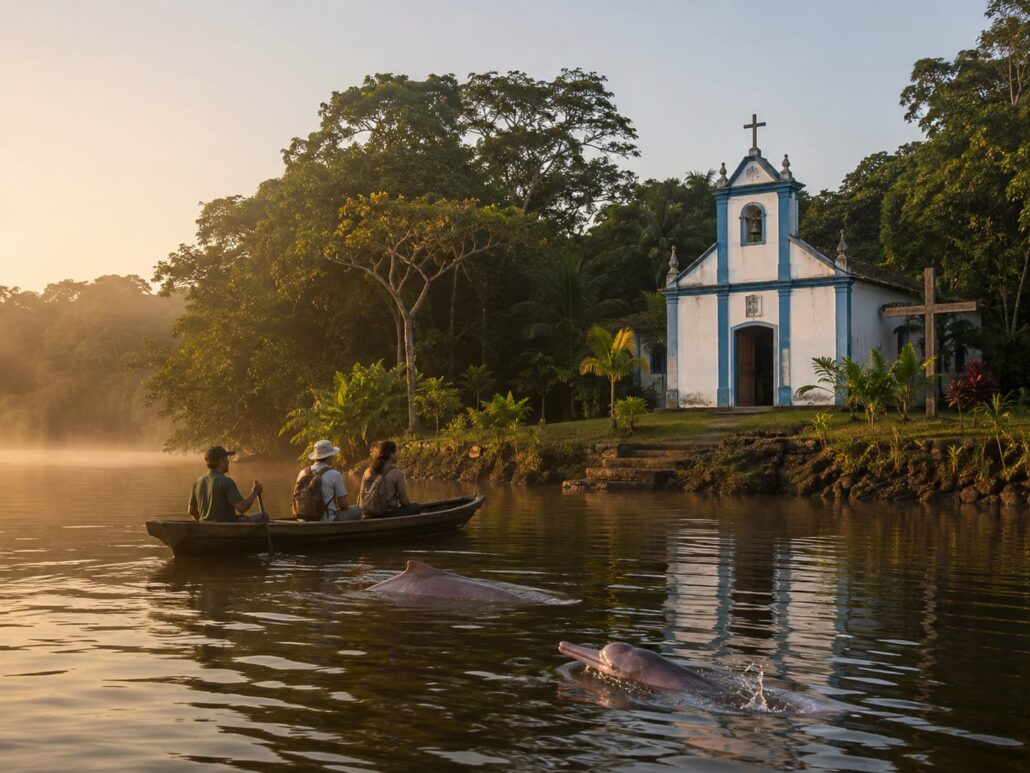
For Catholics who approach a visit to the Brazilian Amazon as a form of spiritual travel — not a conventional pilgrimage to a shrine, but an encounter with sacred Creation — certain spiritual preparations can deepen the experience.
Reading Laudato Si and Querida Amazonia before departure. Both documents are freely available and relatively short. Reading them in advance means arriving in the Amazon with a theological framework that makes the experience legible as more than tourism.
Praying the Canticle of the Creatures. Saint Francis’s prayer, which praises God through the elements of Creation, has particular resonance in the Amazon. Bringing it as a daily prayer during the trip provides a devotional anchor.
Reflecting on the Amazon Synod’s three dreams. In Querida Amazonia, Pope Francis articulates three dreams for the Amazon: a social dream of communities that flourish without exploitation, a cultural dream of the richness of indigenous cultures being preserved and celebrated, and an ecclesial dream of a Church that is genuinely inculturated in the Amazon. Holding these dreams consciously during a visit transforms the encounter from observation to participation.
Attending Mass in Manaus before departing into the jungle. Manaus has a rich Catholic heritage including the iconic Teatro Amazonas (Amazon Theatre), built during the rubber boom, and numerous historic churches. Beginning the journey with the Eucharist in a Manaus parish situates the experience within the communion of the universal Church.
Practical Guidance for Catholic Travelers to the Amazon
The Brazilian Amazon is a serious destination that requires genuine preparation regardless of the spiritual dimension of the journey. Brazilian Amazon Tours provides comprehensive guidance on logistics, but a few points deserve specific mention for Catholic travelers.
Yellow fever vaccination is required or strongly recommended depending on nationality and onward destinations. This is non-negotiable for most travelers and should be arranged weeks in advance through a travel health clinic.
The best season for most travelers runs from June through November (dry season), when trails are passable, wildlife concentrates near water sources, and conditions for jungle trekking are most reliable. The wet season (December through May) offers a different but equally extraordinary experience, with flooded forests accessible by boat that cannot be reached in the dry months.
Day tours versus multi-day experiences. A single full day — the Amazon Jungle Tour Full Day in the Rainforest, which is the most-booked tour on the platform with over 1,800 departures — provides a genuine introduction: jungle trek, pink dolphin encounter, traditional lunch with a local family, piranha fishing, and nighttime caiman spotting. For travelers who want to deepen the encounter, the overnight experience adds a morning wildlife walk and indigenous village visit. Three to five days opens up the full range of river, lodge, and community experiences that make the Amazon genuinely transformative.
Small group size matters. The best operators cap groups at 10 to 12 people. The Amazon is not a place where a bus-tour scale of experience makes sense; the depth of encounter with wildlife and community depends on moving quietly, staying flexible, and maintaining the kind of attentiveness that large groups preclude.
Brazil’s Catholic Calendar and the Amazon
For Catholic travelers planning their visit in connection with the liturgical year, several significant dates offer meaningful context.
Our Lady of Nazaré (Cirio de Nazaré) — celebrated in October in Belém, at the mouth of the Amazon River, this is one of the largest Catholic processions in the world, drawing over two million participants annually. A visit to Belém during this feast — combining the Cirio with a journey deeper into the Amazon — provides an encounter with Brazilian Catholicism at its most spectacular.
Feast of Saint Francis of Assisi (October 4) — the patron of ecology and the namesake of the current Pope, Saint Francis’s feast day has particular resonance in the Amazon context. Many churches across Brazil mark this day with blessings of animals and natural elements that echo the Canticle of the Creatures.
The Amazon Synod anniversary (October) — for Catholics who have engaged with the Synod’s themes, October carries the memory of that gathering and its ongoing implications for the Church’s relationship with the Amazon and its peoples.
Conclusion: What the Amazon Offers the Catholic Imagination
The Catholic tradition has always understood that God speaks through Creation — that the natural world is a form of divine revelation available to every human being before a single word of Scripture is read. But most Catholics encounter Creation in forms that have been substantially shaped by human activity: cities, suburbs, parks, managed forests. The Amazon presents something different: a form of Creation that has not been fundamentally altered, where the web of life operates at a scale and complexity that exceeds human engineering by orders of magnitude.
Encountering this — walking through primary rainforest with a local guide who reads the trees and the sounds the way a scholar reads a text, swimming alongside pink river dolphins in black water, sitting in a boat at night while the jungle speaks in every register around you — does something to the imagination that nothing else does quite the same way. It makes the claims of Catholic creation theology feel not merely credible but unavoidable.
The Amazon does not need to be visited to be prayed for. But visiting it, understanding its history, and encountering the communities who have lived within it in relationship with the Church for generations, creates a quality of knowledge and care that prayer alone cannot generate.
For travelers ready to make that encounter, Brazilian Amazon Tours provides the practical framework: verified local operators, small-group experiences, and the logistical support that the remote Amazon demands. The spiritual preparation is your own to bring.
[For more on Catholic tradition, faith formation, and the life of the Church, explore the news and articles on this site.]
About the author: Written by a Catholic travel writer with particular interest in faith-based travel, creation theology, and the intersection of Church history and the natural world.